BS 9999 Fire Alarm Guidance: The Full Decision Method for Fire Risk Assessors
This is the full, clause-by-clause version of our guidance on determining fire detection and alarm provision in non-domestic premises using
This is a demo store for testing purposes — no orders shall be fulfilled. Dismiss
This is a demo store for testing purposes — no orders shall be fulfilled. Dismiss
There are three methods for predicting the effects of hearing protection so that its suitability can be assessed:
Calculating the predicted level of protection offered by an item of hearing protection can be done using the formulae presented in Appendix 3 of the Guidance on the Control of Noise at Work Regulations (L108). Alternatively, a calculator is available on the HSE website. This spreadsheet allows any of the three methods described to be used and the result can be saved for reference.
Whichever method is used, a 4dB addition is always made to the predicted noise exposure at the ear to take account of ‘real world’ factors. This reflects the fact that the attenuation data for hearing protection is collected in idealised laboratory conditions by the manufacturer and so a margin of error has to be included to allow for imperfect use.
Using the methods described above, the level of noise that will be experienced by an individual at the ear when wearing a certain type of hearing protection can be reliably estimated. This predicted noise level must be below the UEAV of 85dB(A). Ideally, it will be between 75–80dB(A). If predicted noise levels are less than 70dB(A) then the hearing protection is unsuitable because it ‘over-protects’ the ear. Over-protection causes difficulties with communication and hearing-warning signals. Users become isolated from their environment, leading to safety risks, and may be inclined to remove the hearing protection and risk damage to their hearing.
Example Use of the SNR Method
A noise survey and assessment has shown that hearing protection must be worn in a workroom. One type of hearing protection has been selected for use, but it must be checked to ensure that it gives the correct level of protection.
The noise survey has indicated that the C-weighted average sound pressure level in the workroom is 92dB(C). The manufacturer’s data sheet for the hearing protection gives the SNR number as 30.
To calculate the estimated sound pressure level at the ear, take the SNR number away from the C-weighted average:
92 – 30 = 62dB(A)
We must then make a 4dB addition to take account of ‘real-world’ factors:
62 + 4 = 66dB(A)
So, a worker wearing the selected hearing protection in the workroom would receive 66dB(A) at their ear.
We must then evaluate this predicted exposure against the CNAW standards to find that we may be below the UEAV (85dB(A)) and the LEAV (80dB(A)) but, unfortunately, we are also below the guideline 70dB(A), which shows that we are ‘over-protecting’ the worker’s hearing. This hearing protection is therefore not suitable for use in the workroom, so another type, offering a lower level of protection, should be found.
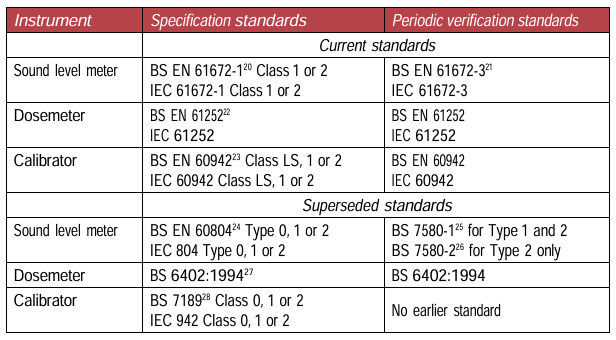
For establishing compliance with the CNAW, the HSE recommend a Class 2 Integrating Sound Level Meter ensuring it is appropriately calibrated before and after each use. The conforming standards are shown below (L108, table 9, page 76).
Both calibrator and sound level meter must be tested and certificated every two years to ensure scientific accuracy.
SME’s may wish to consider cost-effective rental options if the business does not wish to purchase the equipment.
Health and Safety Consultants based in Leicester and operating nationwide.
Direct access to an experienced health and safety consultant
Trusted advice aligned with UK legal duties
Practical solutions that protect directors and businesses
Relationship-led support, built on long-term trust
No long contracts or restrictive tie-ins
Credible support respected by insurers and regulators
This is the full, clause-by-clause version of our guidance on determining fire detection and alarm provision in non-domestic premises using
HSE has taken landmark enforcement action against an occupational health service provider, issuing its first ever Prohibition Notice after inadequate health surveillance put workers at risk of serious harm. A practical guide for UK employers and SMEs on what happened, why it matters, and the questions to ask your occupational health provider.
A practical, plain-English guide to head protection in the workplace for SMEs, based on HSE guidance L25 – the types of helmet available, bump cap vs safety helmet, key checks before use and when hard hats should be replaced.