BS 9999 Fire Alarm Guidance: The Full Decision Method for Fire Risk Assessors
This is the full, clause-by-clause version of our guidance on determining fire detection and alarm provision in non-domestic premises using
This is a demo store for testing purposes — no orders shall be fulfilled. Dismiss
This is a demo store for testing purposes — no orders shall be fulfilled. Dismiss
First, you need to reasonably determine whether you have a noise problem. The HSE give you a list of things to consider.
https://www.hse.gov.uk/noise/advice-overview.htm
If you decide you may have a noise problem, you need to get reliable estimates and conduct a survey using an appropriate sound level meter .
Instrumentation
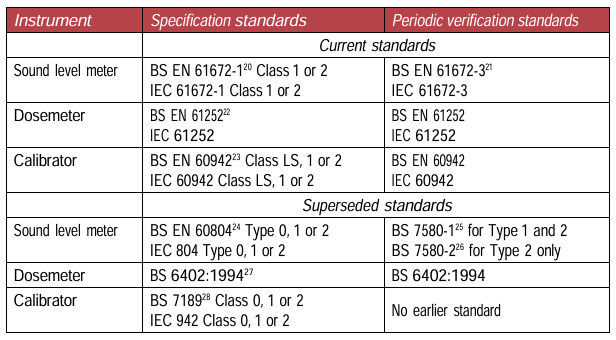
The sound level meter used must be a Class 2 integrating sound level meter or better, with an in-date certificate of test and a suitably tested calibrator. Dosimeters might be used where workers move around in the workplace, preventing the measurement of exposure at static locations.
Several different categories of instrument are available:
This gives a read-out of the sound level at that moment in time, usually with the facility to switch between A-weighting and C-weighting. These are basic meters that are suitable for the measurement of continuous or intermittent periods of steady noise. They can also be used where the noise fluctuates moderately. If the noise is non-impulsive and fluctuates through a range less than 5dB(A), the average reading of the meter can be estimated by eye if the response of the meter is set to ‘slow’.
Simple sound level meters are convenient for making routine spot checks, but are not considered adequate for establishing compliance with CNAW.
These are general-purpose meters that are capable of measuring the noise levels over a period of time and adding them together (integration) to give an average value for the measurement period. This value is called the Leq.
For use in compliance with CNAW, such a meter must be a:
– Class 2 instrument (BS EN ISO 61672-1:2013).
– Equivalent continuous A-weighted sound pressure level (LAeq or Leq dB(A)), which is used to calculate the daily personal noise exposure (LEP,d).
– Maximum C-weighted peak sound pressure level (LCPeak).
An octave band analyser is a type of ISLM that allows frequency analysis of the noise to be carried out. Many ISLMs have a built-in octave band analysis function. Frequency analysis is the process of analysing noise by looking at the sound pressure level at different frequencies.
These devices are worn by the person whose exposure is being determined, to measure the total noise dose over the whole working period. The equipment consists of a small, portable amplification and recording unit that can be worn in a pocket or on a belt by the operator, and a flexible microphone unit that can be attached to a collar or supported from a helmet. However, if the microphone is mounted too close to the person’s body, reflections from the person will reduce the accuracy of the measurement. These meters are also susceptible to abuse by the wearer (e.g. tapping the microphone). For use in compliance with CNAW, it must, at least, comply with BS EN 61252.
The important point is to ensure that the microphone is positioned close enough to the operator’s head to obtain a reliable assessment of the noise to which they are exposed.
The Importance of Calibration
The meter should be calibrated before and after use to ensure the noise measurements accurately reflect the actual noise intensities. A separate calibrator is used for this purpose; this produces a pure tone of a set intensity against which the meter can adjusted.
For use in compliance with CNAW, calibrators should be at least Class 2, BS EN 60942.
Both calibrator and sound level meter must be tested and certificated every two years to ensure scientific accuracy.
Calculating Noise Exposure
It is important to appreciate the two terms ‘LAeq’ and ‘LEP,d’:
The Control of Noise at Work Regulations 2005 use LEP,d (daily dose) as one standard for noise exposure. Therefore, using an ISLM to measure LAeq does not allow direct comparison with the legal standards. First, the measurement must be used to calculate LEP,d. If a single noise exposure occurs during the working day and the working day lasts for eight hours exactly, then this is simple, since LEP,d will be the same as the measured LAeq.
But where the duration of exposure is less, or greater than, exactly eight hours, or where multiple exposures occur, then LEP,d will have to be calculated.
The HSE noise calculator will allow you to calculate the LEP,d and record your findings. You can find the noise calculator here:
https://www.hse.gov.uk/noise/calculator.htm
Purchasing an integrating sound level meter capable of taking LAeq and LCpeak measurements can be expensive for SME’s. You may want to consider renting options available here:
https://www.noisemeters.co.uk/hire/?srsltid=AfmBOorFfqDeywaKhxKgYitlgC5zPpzwFAJekIW6wOSzEOgid2Sk5pZ-
You are strongly recommended to attach your specification sheet of your integrating sound level meter to your survey, or provide a means of showing that an appropriate ISLM was used for the survey.

Health and Safety Consultants based in Leicester and operating nationwide.
Direct access to an experienced health and safety consultant
Trusted advice aligned with UK legal duties
Practical solutions that protect directors and businesses
Relationship-led support, built on long-term trust
No long contracts or restrictive tie-ins
Credible support respected by insurers and regulators
This is the full, clause-by-clause version of our guidance on determining fire detection and alarm provision in non-domestic premises using
HSE has taken landmark enforcement action against an occupational health service provider, issuing its first ever Prohibition Notice after inadequate health surveillance put workers at risk of serious harm. A practical guide for UK employers and SMEs on what happened, why it matters, and the questions to ask your occupational health provider.
A practical, plain-English guide to head protection in the workplace for SMEs, based on HSE guidance L25 – the types of helmet available, bump cap vs safety helmet, key checks before use and when hard hats should be replaced.