BS 9999 Fire Alarm Guidance: The Full Decision Method for Fire Risk Assessors
This is the full, clause-by-clause version of our guidance on determining fire detection and alarm provision in non-domestic premises using
This is a demo store for testing purposes — no orders shall be fulfilled. Dismiss
A machine manufacturing company in Shepshed, Leicestershire, has been fined £170,000 after an employee’s fingers were crushed when his hand became trapped beneath a three-tonne machine during a lifting operation involving a forklift truck.
The incident occurred in January 2024 at the premises of Winbro Group Technologies Ltd and resulted in the amputation of two of the worker’s fingers following hospital treatment. The prosecution was heard at Leicester Magistrates’ Court in May 2026.
This case is a clear reminder that every lifting operation, however routine it may seem, must be properly planned and carried out safely. Failures in planning cost businesses dearly — and can cost workers far more.
An experienced machine tool fitter was working at the Winbro Group Technologies Ltd manufacturing site in Shepshed when his right hand became trapped beneath the foot of a three-tonne machine during a lifting operation involving a forklift truck.
An unintended action caused the forklift truck’s forks to drop to the floor while the worker’s hand was underneath the machine. The machine had to be lifted to free him. Following medical treatment, he underwent surgery to amputate two damaged fingers.
Winbro Group Technologies Ltd pleaded guilty to breaching Regulation 8(1) of the Lifting Operations and Lifting Equipment Regulations 1998 (LOLER). The company was fined £170,000, ordered to pay prosecution costs of £7,999 and a victim surcharge of £2,000.
The Lifting Operations and Lifting Equipment Regulations 1998 (LOLER) place specific duties on employers who use lifting equipment as part of their work activities.
Regulation 8 requires that every lifting operation is properly planned by a competent person, appropriately supervised, and carried out in a safe manner. Where it is not reasonably practicable to avoid people working beneath suspended loads, employers must establish safe systems of work to minimise the risk, including ensuring loads are properly secured.
This duty applies to every lifting operation — including everyday tasks carried out with forklift trucks. Routine does not mean low risk. Familiarity with a task can itself become a hazard if planning and supervision are allowed to slip.
Following the prosecution, HSE Inspector Rebecca Whiley said: “Every year, a significant proportion of accidents, many of them serious and sometimes fatal, occur as a result of poorly planned lifting operations. This was a wholly avoidable incident caused by a lack of planning. HSE will not hesitate to take action against dutyholders who fail to do all that they should to keep people safe.”
Despite LOLER having been in force since 1998, lifting accidents continue to occur across manufacturing, engineering, warehousing and logistics businesses. In most cases the root cause is not a lack of equipment — it is a failure to plan, supervise and apply safe systems of work.
During workplace inspections carried out as part of our competent person service, we observe lifting activities and ask the questions that identify risk before an incident occurs:
If these questions had been asked and acted upon at Winbro Group Technologies, this incident could have been avoided entirely.
Under the Management of Health and Safety at Work Regulations 1999, every employer must appoint one or more competent persons to assist in meeting their health and safety duties. For many SMEs, providing that competence in-house is not always practical.
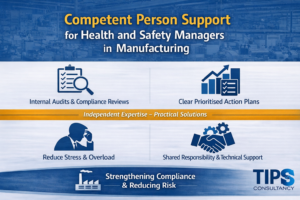
The TIPS Consultancy 12-month Competent Person Service is designed for exactly this purpose. It is not a one-off visit or a set of template documents. It is an ongoing support arrangement that helps your business identify risk, stay legally compliant and demonstrate to the HSE, insurers and clients that health and safety is being managed properly throughout the year.
As part of the service, we can review your LOLER arrangements and lifting operation procedures, develop or review safe systems of work for higher-risk activities, carry out workplace inspections that look at what actually happens on site rather than what the paperwork says, and provide practical advice proportionate to your operations and workforce.
This case is one example of what can go wrong when lifting operations are not properly planned. TIPS Consultancy Ltd works with SMEs throughout the year as their appointed competent person, helping to identify gaps before they become incidents.
Clients who subscribe to the 12-month Competent Person Service receive ongoing support with LOLER compliance, safe systems of work, workplace inspections and health and safety documentation — all proportionate to the size and nature of their business.
TIPS Consultancy Ltd provides practical health and safety support for small and medium-sized businesses across manufacturing, engineering, warehousing and other higher-risk environments. We offer straightforward, experienced advice from consultants who understand the realities of running a business.
If your business uses forklift trucks, overhead cranes, hoists, lifting accessories or any other lifting equipment and you are not fully confident that your LOLER arrangements are in order, we can help. Get in touch to find out more about the 12-month Competent Person Service and how TIPS Consultancy supports businesses across the East Midlands and beyond.

Health and Safety Consultants based in Leicester and operating nationwide.
Direct access to an experienced health and safety consultant
Trusted advice aligned with UK legal duties
Practical solutions that protect directors and businesses
Relationship-led support, built on long-term trust
No long contracts or restrictive tie-ins
Credible support respected by insurers and regulators
This is the full, clause-by-clause version of our guidance on determining fire detection and alarm provision in non-domestic premises using
HSE has taken landmark enforcement action against an occupational health service provider, issuing its first ever Prohibition Notice after inadequate health surveillance put workers at risk of serious harm. A practical guide for UK employers and SMEs on what happened, why it matters, and the questions to ask your occupational health provider.
A practical, plain-English guide to head protection in the workplace for SMEs, based on HSE guidance L25 – the types of helmet available, bump cap vs safety helmet, key checks before use and when hard hats should be replaced.

Related service: Risk Assessment Support (Leicester & the Midlands) – we write your risk assessments with you, on site, for
n Related service: Competent Person Service for manufacturing & industrial SMEs in Leicester & the Midlands – an appointed external

Why Every Business Should Use a Visitor Sign-in Record Visitors come into businesses every day. Contractors, delivery drivers, clients, auditors,
Guidance Note: Basic Noise Survey Advice for SME’s First, you need to reasonably determine whether you have a noise problem.
Guidance Note: Selecting Suitable Hearing Protection – The Control of Noise at Work Regulations 2005 There are three methods for

Managing Stress in Health and Safety Roles – A Message for HR Managers Engaging an external competent person or experienced
Why Health and Safety Managers Should Engage External Competent Support Engaging an external competent person or experienced health and safety