BS 9999 Fire Alarm Guidance: The Full Decision Method for Fire Risk Assessors
This is the full, clause-by-clause version of our guidance on determining fire detection and alarm provision in non-domestic premises using
This is a demo store for testing purposes — no orders shall be fulfilled. Dismiss
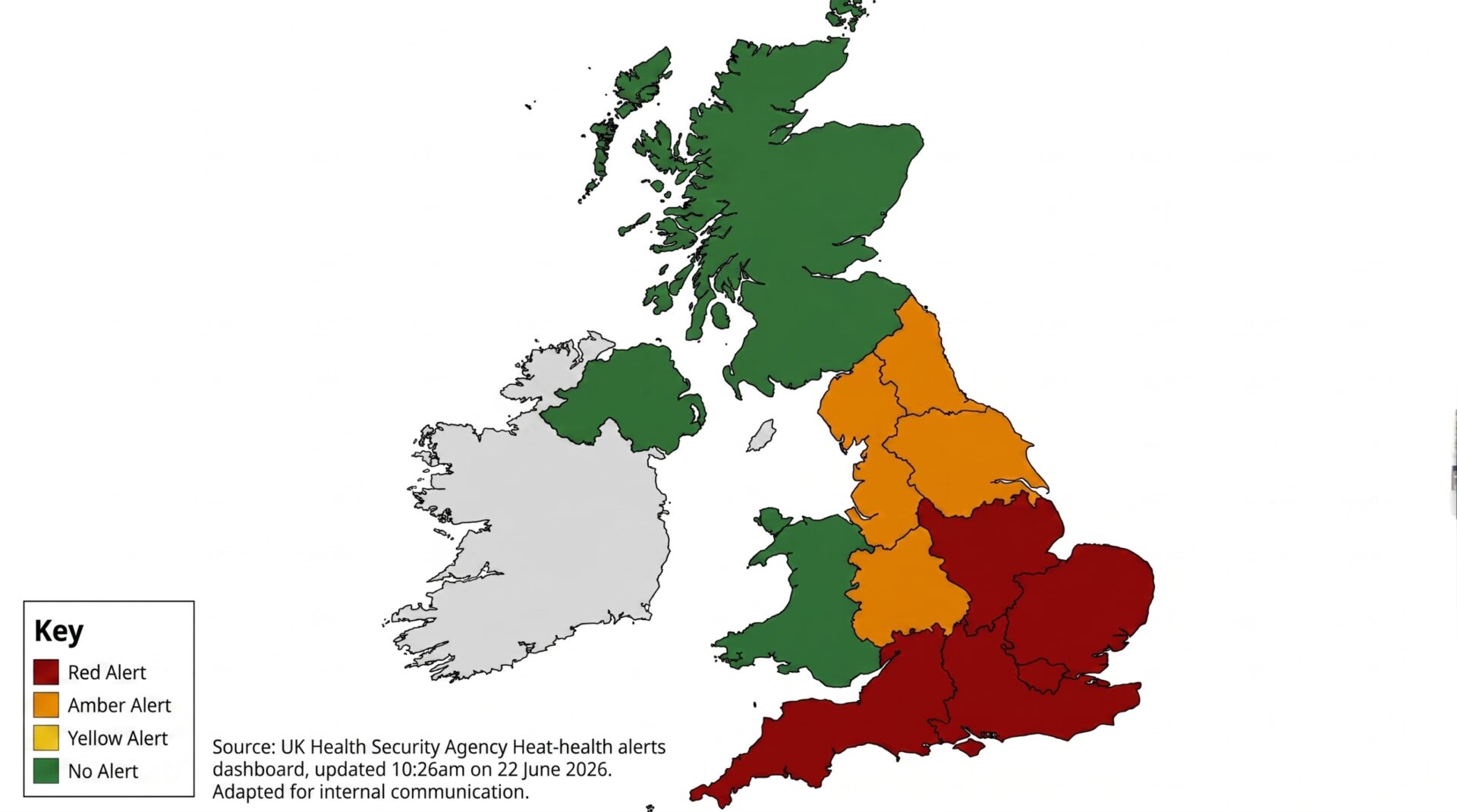
With the Met Office issuing a rare Red Extreme Heat Warning and the UK Health Security Agency (UKHSA) placing much of England – including the East Midlands – under a Red heat-health alert for Wednesday 24 and Thursday 25 June 2026, temperatures are forecast to climb close to 39°C. For employers, a heatwave is not just a question of comfort. Heat is a workplace hazard, and like any other hazard it needs to be assessed and controlled. This guide sets out the practical control measures small and medium-sized businesses should consider as part of their hot weather risk assessment – and how to keep up with official alerts so you are never caught out.
One of the most common questions employers ask during a heatwave is whether there is a legal maximum temperature at which staff can be sent home. The short answer is no. There is no upper limit set in law, because in some workplaces – bakeries, foundries, commercial kitchens – high temperatures are created by the work itself. What the law does require is a reasonable temperature. Regulation 7 of the Workplace (Health, Safety and Welfare) Regulations 1992 states that the temperature in all indoor workplaces during working hours must be reasonable. HSE guidance suggests indoor workrooms should normally be at least 16°C, or 13°C where the work involves significant physical effort. Crucially, Regulation 3 of the Management of Health and Safety at Work Regulations 1999 requires every employer to carry out a suitable and sufficient risk assessment of foreseeable hazards – and a summer heatwave is exactly that. Heat is classed as a hazard and should be treated like any other.
On 19 June 2026, the HSE used the arrival of the hot weather to remind employers of their legal duty to protect workers from extreme heat, noting that it sees a surge in people seeking advice during hot spells. UKHSA has since escalated its warnings: Red heat-health alerts are in force from 1am on Wednesday 24 June until 11pm on Thursday 25 June for the East of England, East Midlands, London, the South East, the South West and the West Midlands, with Amber alerts for the North East, North West and Yorkshire and the Humber. Overnight ‘tropical nights’, where the temperature does not fall below 20°C, will make it harder for staff to recover between shifts. A Red alert signals a risk to life even for healthy people – so the time to act is now, before Wednesday, not on the day itself.
There is no single fix; the right controls depend on your premises, your work and your people. Drawing on HSE guidance and a typical workplace heat policy, here are the measures SMEs should consider and document in their risk assessment:
Your risk assessment should give particular attention to anyone at greater risk. Staff working outdoors should, where possible, avoid direct sun between 11am and 3pm, work in the shade, wear sunscreen and a suitable hat, avoid extreme physical exertion, drink plenty of cold fluids and eat cold foods with a high water content. Some workers are also more vulnerable to heat than others: new and expectant mothers should have a personal risk assessment that considers the thermal environment, and staff with certain medical conditions, older workers, and those fasting for religious reasons may all need individual consideration. With more people now working from home under agile arrangements, it is worth reminding homeworkers to apply the same sensible measures where they can.
One of the most effective – and free – control measures is simply knowing when hot weather is coming, so you can act in advance rather than react on the day. Two official sources make this easy, and we recommend building both into your safe system of work:
Checking these at the start of the week – and again whenever an alert is issued – lets you brief staff, adjust shifts and put your control measures in place before the temperature peaks.
Heat stress can affect anyone, indoors or out. Early signs include tiredness, dizziness, headache, muscle cramps, heavy sweating and difficulty concentrating. If these are ignored, they can progress to heat exhaustion or potentially life-threatening heatstroke. Make sure managers and staff know to move an affected person somewhere cool, give them water, loosen tight clothing and cool their skin – and to call 999 if they do not improve within 30 minutes or show signs of heatstroke such as confusion, hot dry skin or loss of consciousness. Sharing this information with your team is a simple, no-cost control measure that could prevent a serious incident.
Under the Management of Health and Safety at Work Regulations 1999, every employer must appoint one or more competent persons to help meet their health and safety duties. For many SMEs, that expertise is not always available in-house – and a heatwave is exactly the kind of foreseeable risk that is easy to overlook until it arrives. As your appointed competent person, we help you put a proportionate hot weather risk assessment in place, identify practical control measures suited to your premises and workforce, and keep your documentation ready to show staff, insurers and the HSE. If you would rather tackle the paperwork together, our risk assessment support service writes your risk assessments with you, on site.
Hot weather is a foreseeable, recurring risk – and one the HSE expects employers to plan for. TIPS Consultancy Ltd works with SMEs throughout the year as their appointed competent person, helping to put simple, proportionate controls in place before problems arise. Clients on our 12-month Competent Person Service receive ongoing support with risk assessments, safe systems of work and health and safety documentation, all proportionate to the size and nature of their business.
TIPS Consultancy Ltd provides straightforward, experienced health and safety support for small and medium-sized businesses across manufacturing, engineering, warehousing, offices and other workplaces. Whether you need help with a one-off risk assessment or year-round competent person support, get in touch to find out how we help businesses across the East Midlands and beyond stay safe and compliant – whatever the weather.

Health and Safety Consultants based in Leicester and operating nationwide.
Direct access to an experienced health and safety consultant
Trusted advice aligned with UK legal duties
Practical solutions that protect directors and businesses
Relationship-led support, built on long-term trust
No long contracts or restrictive tie-ins
Credible support respected by insurers and regulators
This is the full, clause-by-clause version of our guidance on determining fire detection and alarm provision in non-domestic premises using
HSE has taken landmark enforcement action against an occupational health service provider, issuing its first ever Prohibition Notice after inadequate health surveillance put workers at risk of serious harm. A practical guide for UK employers and SMEs on what happened, why it matters, and the questions to ask your occupational health provider.
A practical, plain-English guide to head protection in the workplace for SMEs, based on HSE guidance L25 – the types of helmet available, bump cap vs safety helmet, key checks before use and when hard hats should be replaced.
Related service: Risk Assessment Support (Leicester & the Midlands) – we write your risk assessments with you, on site, for
n Related service: Competent Person Service for manufacturing & industrial SMEs in Leicester & the Midlands – an appointed external

Why Every Business Should Use a Visitor Sign-in Record Visitors come into businesses every day. Contractors, delivery drivers, clients, auditors,
Guidance Note: Basic Noise Survey Advice for SME’s First, you need to reasonably determine whether you have a noise problem.
Guidance Note: Selecting Suitable Hearing Protection – The Control of Noise at Work Regulations 2005 There are three methods for

Managing Stress in Health and Safety Roles – A Message for HR Managers Engaging an external competent person or experienced
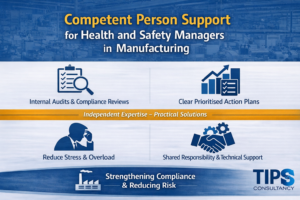
Why Health and Safety Managers Should Engage External Competent Support Engaging an external competent person or experienced health and safety